Blog
Reducing the prevalence of Dementia

Like many of you, my family is familiar with the ravages of Dementia. My father died from Lewy Body disease. My younger brother has the disease. My paternal grandfather died from Alzheimer’s. I watched Dementia hollow them out.
With the number of senior citizens growing and longevity increasing, the global number of people with Dementia will increase. A recent study projected that the number of new cases of Dementia in America will double from around 500,000 a year in 2020 to 1,000,000 a year by 2060.
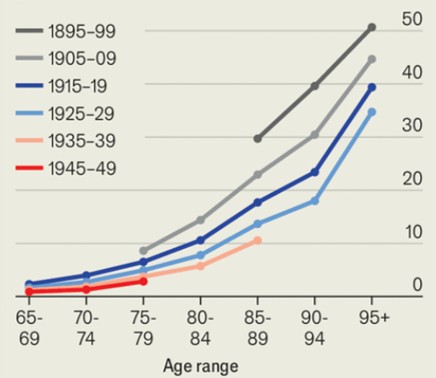
Surprisingly, the percent of elderly people who have Dementia has been decreasing over the years. You can see this in the graph in this post (which appeared in a recent issue of the Economist) that shows the percent of people in the US with Dementia by age.
Looking at the graph, for people older than 95 and born in 1895-1899, the percent who had Dementia was 50%. However, if you were born in 1925-1929 and were older than 95, the percent who had Dementia was 35%. Forty years ago, three in every ten Americans aged 85-89 had Dementia, by 2024 just one in ten had it.
(Because so many people are living longer, this prevalence decrease slows the growth rate in the number of new cases but doesn’t stop or reverse it.)
Why the decrease in prevalence?
Below is a list of factors that increase the risk of Dementia.
Some factors are outside of the control of a person or the health care system. We are all aging (Age is the most significant factor). Our genetic makeup can elevate the risk of Dementia.
However, some factors involve lifestyle choices – smoking, alcohol consumption, how well we manage a chronic disease and physical activity. Some factors can be addressed through primary care and behavioral health care interventions – depression, diabetes, vision and hearing loss and hypertension. Some factors can be addressed through choices we make as a society – air pollution, social isolation and education for kids.
Dementia Risk Factors
Age
Genetics
Depression
Traumatic brain injury
Diabetes
Less education
Social isolation
Untreated vision loss
Untreated hearing loss
Obesity
High cholesterol
Smoking
Excessive alcohol consumption
Hypertension
Physical inactivity
Air pollution
It is estimated that as many as 45% of dementia cases worldwide could be delayed or prevented by addressing these risk factors.
Reducing the prevalence of Dementia is a very significant and compelling goal. It is also a challenging goal to achieve and to continue to achieve. As we have learned from our efforts to tackle the prevalence of heart disease and cancer, reducing the personal and societal toll of these diseases involves a complex mix of personal choices, social choices and the accessibility and quality of health care. While complicated and challenging, we have shown that we can make real progress.
The progress made in achieving the goal is truly remarkable. But we are not done.
There is a saying in our family, “The Glaser’s live forever. They just don’t know it.”
I’d like my grandkids to be able to tell their kids that that saying used to be true but isn’t anymore.