Blog
Evolving the brain

Our brains are the result of evolution that has occurred over hundreds of millions of years.
The earliest vertebrates (500 plus million years ago) had relatively simple brains devoted to survival; detecting predators and prey, coordinating movement, and processing basic sensory information.
The brains of early mammals (200-250 million years ago), gained capabilities such as better memory, more sophisticated learning ability, enhanced smell and advances in parental care competency and social behavior.
Primates (50-60 million years ago) evolved in complex forest environments where survival required good vision, hand-eye coordination, and social intelligence. Their brains expanded in regions involved in visual processing, planning, social relationships, and memory. Living in groups may have been a major driver of brain growth. Understanding alliances, rivals, and social status required substantial cognitive power.
The ancestors of modern apes (15-25 million years ago) developed greater problem-solving ability, more flexible behavior, and more sophisticated communication. These brains supported longer childhoods, during which young animals learned from adults.
After the human lineage split from that of chimpanzees (6 million years ago), brain size increased dramatically. This larger size enabled making and using tools. The ability to cooperate, detect deception, communicate, and understand others’ intentions enabled the formation of complex social groups. The advent of language abilities allowed information to be shared across generations.
Today’s human brain has continued to evolve, providing capabilities such as abstract reasoning, imagination, long-term planning and the creating complex cultures and social structures.
Many neuroscientists view the human brain as a layered system:
- Ancient circuits for survival and emotion
- Mammalian circuits for learning and social bonds
- Highly developed cortical networks for reasoning, language, and imagination
Rather than replacing older structures, evolution added new capabilities on top of existing ones.
Of course, this begs the question. Since evolution never ends, how do scientists think that brain will continue to evolve in the years ahead? What new capabilities will be layered on top of our brains?
The next layer of capabilities will likely be driven more by technological advances than biological advances. Technology moves much faster than changes in biology. Hence, the next wave of changes to the brain may happen relatively quickly – over centuries rather than millions of years.
The evolutionary path of our brains in the years ahead is unclear but we can make reasonably well-informed projections based on what we know about technology today.
In the next 200 years, brain-computer interfaces for medical use, which already exist in basic forms, will become common. AI systems will handle memory, organization, navigation, and education and will shift people towards critical thinking rather than memorization.
In 200 to 1,000 years, we are likely to see genetic engineering designed to eliminate Alzheimer’s and other severe disorders of the brain. Digital technology may enable long-term, semi-permanent brain-computer interfaces which will provide direct neural access to cloud memory and augmented reality in the brain (rather than via gaming goggles).
In 1,000 to 5,000 years, we may see the ability to select, based on the understanding of genomics, embryos based on likely intellect, memory and ability to handle anxiety. In the digital realm, we may be able to store our memories externally and form thought networks with other people.
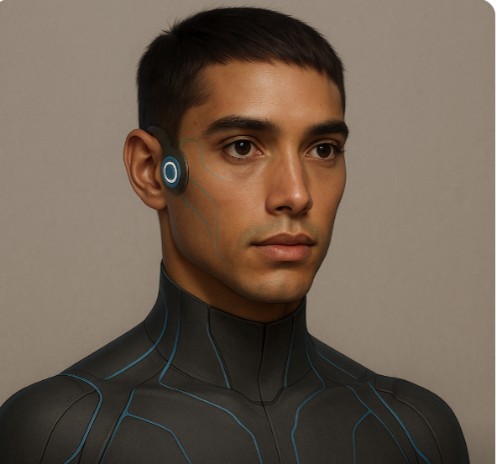
As we shift from biological evolution to technology evolution, the pace of evolution of the brain is likely to increase dramatically. The humans that are around 5,000 years from now may not look any different than humans today (there won’t have been enough time for significant biological evolution), but the capabilities and definition of their brains (enabled by the electronics next to his ear in the picture in this post) might be very different.
This makes me want to invent a time machine so that I can see how we evolve. I’ll keep you all posted as I develop it.