Blog
Measuring happiness

On the occasion of my recent birthday, a friend asked me, “If you could go back to being 20 years old, or 40 years old, would you?”
No.
While I enjoyed those ages, I have found that I am happier in each decade than I was in the decade before it.
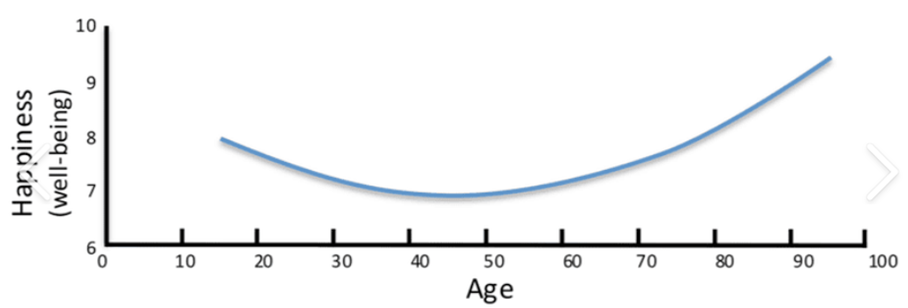
I am not alone in this observation. Apparently, the happiness of people varies by age. As the graph shows, happiness tends to be higher when you are younger and when you are older. It dips in middle age.
Why?
When you are young, life is full of romance, professional and personal promise. There is an optimism about what awaits you.
When you are middle aged, several stressors converge. There are often complicated and conflicting demands of family, career and finances. You may realize that some of the expectations of your youth are not working out.
When you are a senior citizen, you often have become content with who you are and your situation in life. You realize that you may not have achieved all your dreams, but you achieved enough to be pleased. In addition, as people become more aware that their time is limited, they often prioritize emotionally meaningful experiences over status, achievement, or wealth.
As you might imagine, a person’s happiness is more than a function of age. Happiness is significantly influenced by other factors.
The World Happiness Report explores the factors that lead to the happiness of a country’s citizens. The report is published by a partnership of Gallup, the Oxford Wellbeing Research Centre, and the UN Sustainable Development Solutions Network. They also assess the relative importance of factors that influence the happiness of a population.
The factors and their importance are:
• Wealth (GDP per capita) – 10%
• Social support (number and strength of close relationships) – 49%
• Life expectancy (health) – 1%
• Freedom to make life choices (your ability to live as you choose) – 14%
• Generosity (tendency to give money and time to others) – 8%
• Freedom from corruption (belief that the “system is fair) – 18%
In 2026, the US ranked number 23 in happiness behind Kosovo but ahead of Uzbekistan. Finland was number 1.
If you want an objective measure of your level of happiness, you might want to take the Oxford Happiness Inventory which is one of most widely used measures of happiness. You can find an online version at https://psytests.org/life/ohien.html
Or you can use the version below. For this version the highest possible overall score is 6; most people score slightly above 4.
Below are several statements about happiness. Indicate how much you agree or disagree with each according to the following code:
1 = strongly disagree • 2 = moderately disagree • 3 = slightly disagree • 4 = slightly agree • 5 = moderately agree • 6 = strongly agree
Items marked (–) should be scored in reverse, where 1 = strongly agree and 6 = strongly disagree.
Your happiness score is the sum of the numbers you have entered divided by 29.
I am very happy
There is a gap between what I would like to do and what I have done (–)
I don’t think I look attractive (–)
I am not particularly optimistic about the future (–)
I laugh a lot
I do not think the world is a good place (–)
I am always committed and involved
I find most things amusing
I feel that life is very rewarding
I am intensely interested in other people
I rarely wake up feeling rested (–)
I have very warm feelings toward almost everyone
I am well satisfied about everything in my life
Life is good
I find beauty in some things
I always have a cheerful effect on others
I can fit in everything I want to
I feel that I am not especially in control of my life (–)
I feel able to take anything on
I feel fully mentally alert
I often experience joy and elation
I do not find it easy to make decisions (–)
I do not have a particular sense of meaning and purpose in my life (–)
I usually have a good influence on events
I do not have fun with other people (–)
I don’t feel particularly healthy (–)
I do not have particularly happy memories of the past (–)
I don’t feel particularly pleased with the way I am (–)
I hope you get a good score.